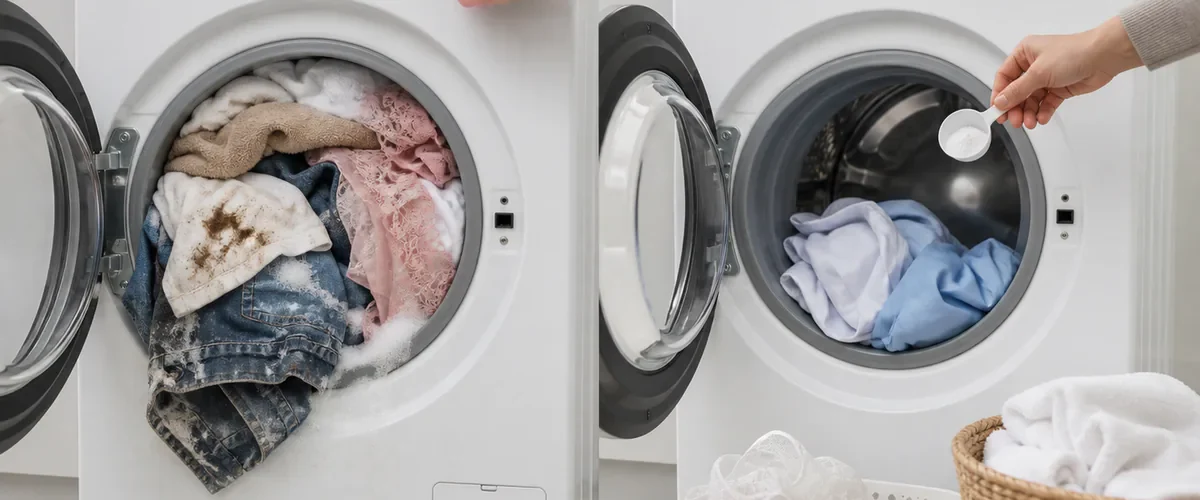
The quick-wash button feels like free time. Thirty minutes later, the door unlocks and the laundry smells clean. Then a shirt keeps its stain, a towel feels full of detergent, and a delicate edge looks stretched.
The short cycle is not a bad setting. It is a specialized one. It works best on the small, lightly soiled load described in the washer manual. Use it for the wrong laundry, and three kinds of load pay the price.
Load 1: Heavy or Deeply Stained Laundry
Mud, body oil, food, makeup, and work grime need time, suitable temperature, detergent action, and movement. A quick cycle shortens one or more parts of that process. A shirt may smell fresher while the soil remains in the fibers.
Check the care label and washer cycle guide. Pretreat stains with a product approved for the fabric, allow the labeled time, and use the normal or heavy-soil setting the manual recommends. Never combine stain products without confirming they are compatible.
Do Not Add Extra Detergent to Make Up for Time
A small quick load usually needs less detergent, not more. Excess can create too many suds, reduce mechanical cleaning, and remain after the shortened rinse. Measure for load size, soil level, water hardness, and the detergent label.
Load 2: A Full Drum of Everyday Clothes
Quick-wash capacity can be far below the machine’s maximum. Some manuals describe only a few lightly soiled items. When the drum is packed, clothes cannot move, water and detergent do not reach evenly, and rinsing suffers.
Read the model’s cycle table rather than guessing from total washer capacity. A load that fits the drum may still be too large for the quick program. Split it or select a cycle rated for the full amount.
Balance Matters Too
One wet towel with several light shirts can become an uneven bundle. The washer may pause, add water, redistribute, or reduce spin speed. A “30-minute” cycle can then last longer and leave clothes wetter.
Wash similar weights together and spread items loosely. Stop the machine according to its manual if it bangs or moves.
Load 3: Delicates and Special-Care Items
Silk, wool, lace, bras, and garments marked hand wash need controlled movement, temperature, and spin. A short program is not automatically gentle. Some quick cycles use more intense action to clean in less time.
Follow each care label and choose the machine’s delicate, wool, or hand-wash cycle when allowed. Place small items in a mesh bag and close hooks. Dry them in the manner stated on the label.
What About Towels, Bedding, and Illness?
Bulky towels and sheets need room to wet, tumble, rinse, and balance. Use the bedding, bulky, cotton, or other suitable program named by the manual. Do not squeeze a duvet into a machine that lacks enough capacity.
Laundry contaminated during illness may need specific temperature, detergent, bleach, and drying guidance based on the item and situation. Follow public-health advice, product labels, and the garment instructions. A hot symbol or short time alone does not prove disinfection.
Does Quick Wash Really Use More Energy?
There is no universal answer for every machine. Energy depends on water heating, cycle design, temperature, load, spin, and any automatic adjustments. The owner’s manual or model data is the best source for the actual program.
A long eco cycle can use less energy than a shorter program because it cleans at lower temperatures over more time. In Europe, washing-machine energy-label figures are based on the Eco 40–60 program. Quick wash should not be assumed to be the cheapest simply because the clock is shorter.
Cold Water Often Saves the Most
Heating water uses substantial energy. For suitable everyday laundry, a cold setting and a compatible detergent can clean well. Oily stains, hygiene needs, and care labels may call for something different.
When the Quick Cycle Is the Right Choice
Use it for a small group of lightly soiled, washable items that need refreshing soon. Examples may include a few everyday shirts worn briefly, provided their colors, fabrics, and labels are compatible.
Check pockets, close fasteners, treat visible spots, and load loosely. Select the allowed temperature and spin. Measure a small-load dose of detergent. Remove the items promptly when the cycle ends.
Four Signs You Chose the Wrong Cycle
- Stains remain after the fabric dries
- Clothes feel slippery, stiff, or strongly scented with detergent
- The washer pauses repeatedly to rebalance
- The same load needs a second wash
A repeat cycle costs more time, water, and energy than choosing correctly once. Record the settings that work for common household loads so everyone using the machine can repeat them.
The quick-wash button saves minutes, but heavy soil, full drums, and delicate fabrics can pay the price. Match the cycle to the load, read the manual’s capacity, and measure detergent. Speed becomes useful when it is treated as the right tool for a narrow job, not the default answer to every basket.