A flowerless orchid can make any quick tonic feel believable. Add a spoonful, wait a few hours, and a “torrent of flowers” is supposed to appear. But an orchid bud is built over weeks, not while you watch the clock. No safe fertilizer can create mature flowers from nothing in one afternoon.
There is still a thrilling moment you can look for. A tiny flower spike emerging from the stem proves that the plant has received enough light, energy, and seasonal signals to begin its next display.
Why Orchid Flowers Cannot Appear in Hours
Before a Phalaenopsis flower opens, the plant must initiate a spike, lengthen it, form buds, and develop each bloom. Those steps require cell division and stored energy. A tonic can provide nutrients only after roots absorb them, and nutrients cannot replace time.
Sometimes a treated orchid already has hidden buds. The timing makes the ingredient look responsible when the flowering process began long before application. This is why one dramatic result does not prove a remedy works.
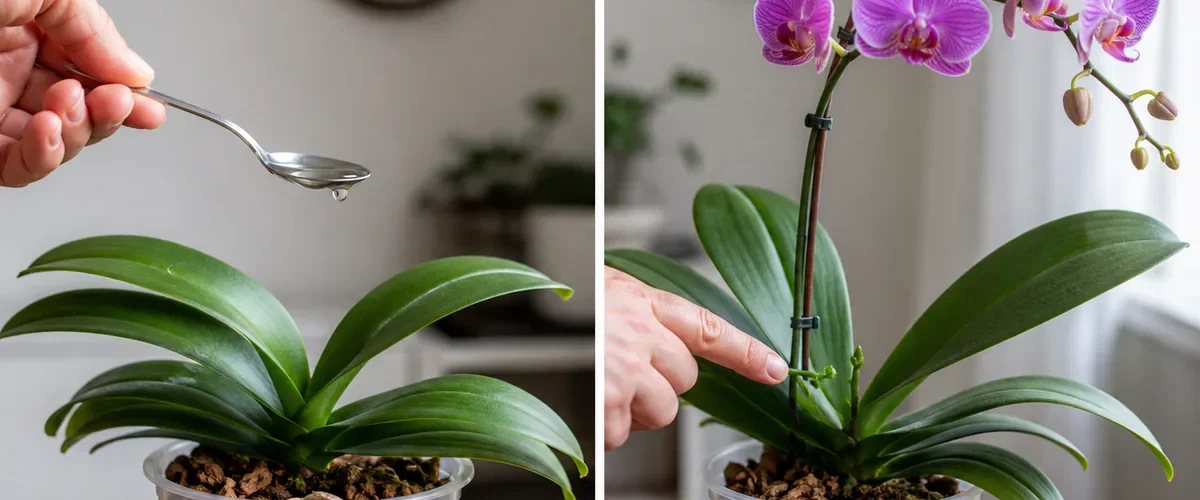
Find the Tiny Sign Worth Watching
On a moth orchid, a new spike usually emerges between leaves. It often has a flattened, mitten-like tip. A new root is rounder, smooth, and bright green at the end. Both are good signs, but only the spike will carry flowers.
Do not poke or bend it to confirm. Take a photograph and check again in a week. A spike develops nodes and grows toward light, while a root seeks moisture and support.
Mark the date on the pot and photograph from the same angle. The record turns slow growth into something visible and prevents hopeful guesses about overnight change.
The Fastest Safe Route Starts With Light
A healthy orchid that makes leaves but never blooms may be living in a dim corner. Move it gradually toward bright filtered light. An east window often suits Phalaenopsis, while harsh midday rays can burn leaves.
Look at the newest leaf, not just old foliage. Very dark green growth can suggest the plant needs more light, though leaf color also varies by variety. Increase brightness slowly and protect the plant with a sheer curtain when necessary.
A Gentle Temperature Change Can Start the Cycle
Mature Phalaenopsis orchids often respond to a period of modestly cooler nights while days remain comfortable. This natural seasonal shift can help trigger a spike. Do not put the plant in a refrigerator, outside in cold weather, or against freezing glass.
Other orchids have different needs. Some Dendrobiums require a distinct rest, while Cattleyas flower from mature new growth. Identify the orchid before copying a routine designed for another type.
Feed Growth Without Burning Roots
Use a complete orchid fertilizer at the label rate during active growth. Apply it to moist roots and allow the pot to drain. An unknown kitchen tonic may contain some nutrients, but its strength and balance are uncertain.
More fertilizer does not mean more flowers. Excess salts damage root tips and can leave white crust on bark or pots. Flush with clean water as appropriate, and reduce feeding when the orchid’s growth slows.
Healthy Roots Power Every Bud
Firm Phalaenopsis roots turn green when wet and silver as they dry. Brown, soft roots cannot absorb water well. Keep the plant in an airy orchid mix and a pot with open drainage.
Water thoroughly, then let it drain completely. Wait until the medium approaches the drying stage appropriate for the orchid before watering again. Never leave the inner pot sitting in water, and keep water out of the crown.
Mistakes That Delay Flowers
Constantly moving the orchid prevents it from adapting to useful light. Repotting while a healthy spike is developing can disturb roots and buds. Heavy pruning may remove living tissue that could rebloom on some Phalaenopsis.
Do not pour several remedies into the pot at once. Coffee, rice water, banana liquid, garlic, sugar, and fertilizer can create residue or rot. Change one condition, record it, and observe the newest growth.
What to Expect After the Spike Appears
A spike may take weeks to lengthen and form buds. Keep the plant away from fruit bowls, heaters, cold drafts, and sudden moves because stress and ethylene from ripening fruit can cause buds to drop.
Support the spike loosely as it grows. Rotate the pot only before buds become heavy; later turning can twist the display. Continue steady water and light rather than forcing the plant with extra feed.
The Real Torrent Begins With One Green Tip
The promise of flowers in hours is biologically impossible, but the wait is not empty. Roots strengthen, a leaf matures, and a small spike appears when conditions finally align.
Skip the instant tonic and watch the stem instead. That tiny green point may look modest, yet it carries the entire future cascade of flowers. Give it time, and the truthful result is still spectacular.