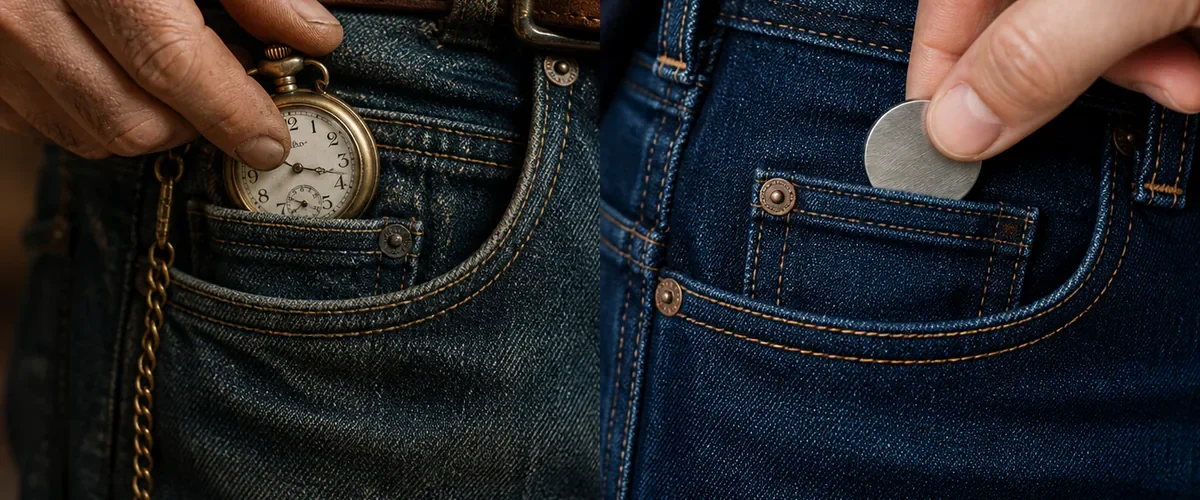
That tiny pocket tucked inside the front of your jeans seems too small for a phone and too awkward for a hand. It survives on denim more than 150 years after the object it protected nearly disappeared.
The little compartment is commonly called a watch pocket. It was designed to hold a pocket watch for workers who needed the fragile timepiece close, secure, and protected from rough tools.
Why Early Jeans Needed One More Pocket
In the nineteenth century, wristwatches were not the everyday standard. A pocket watch could be attached to a chain, but it still needed a snug place where it would not swing against equipment or fall into dust.
Work trousers were built for durability. Rivets strengthened high-stress points, heavy denim resisted wear, and the small front pocket gave a watch its own protected compartment.
The detail became part of the visual language of classic five-pocket jeans: two front pockets, two rear pockets, and the little watch pocket nested inside one front pocket.
Why It Stayed After Wristwatches Took Over
Clothing details often outlive their original tools. The watch pocket became a familiar sign of traditional jeans construction. Removing it could make a classic pair look strangely unfinished.
Factories already had patterns and equipment for the piece. Brands also used its stitching, shape, rivets, and placement as part of their identity.
Most importantly, a tiny pocket remained useful. People adapted it for coins, tickets, tokens, guitar picks, and other small objects.
What Fits in the Pocket Today?
A folded transit ticket, shopping-cart token, guitar pick, or small lucky coin can fit. Some wireless-earbud cases fit wider modern versions, although a tight pocket may press buttons or make the case hard to remove.
Use it only for an object that is smooth, clean, and large enough not to disappear into the bottom seam. Empty the pocket before laundry.
The best modern use may be symbolic: it carries one small thing you do not want mixed with keys and receipts in the main pocket.
Objects You Should Not Store There
Do not place an unprotected razor blade, medication, loose battery, sharp key, or leaking cosmetic in the pocket. Pressure from sitting can damage the object or injure you.
A condom should not live for long periods in a tight jeans pocket. Heat, friction, and package damage can reduce reliability. Follow the product’s storage directions and inspect the package before use.
Memory cards and tiny jewelry can be forgotten and destroyed in the washer. Expensive objects deserve a closed case or zipped pocket.
How to Inspect the Construction
Turn the pocket edge outward gently without forcing it. Look for tight stitching, secure rivets, and no sharp metal. A rivet that loosens or a seam that opens can scratch skin or release a small object.
Do not cut the pocket larger. It may share fabric with the main front pocket, and an unplanned cut can weaken both pieces.
If repair is needed, a tailor can reinforce the edge while preserving the original look. Vintage jeans may have collector value, so ask before replacing hardware.
Wash the Tiny Pocket Properly
Check it before every wash. A coin can strike the machine drum, a tissue can create lint, and a pen can stain an entire load.
Turn jeans inside out, close zippers, and follow the care label for water temperature and drying. Washing only when needed reduces fading and friction.
Air-dry when the label and conditions allow, keeping dark denim out of harsh sunlight. Never use a cleaning method simply because the jeans look rugged; stretch denim and specialty finishes need care.
Common Myths About the Pocket
It was not invented for modern coins, smartphones, or disposable lighters, even though later generations used it for many of those things. Its original story belongs to the pocket watch.
It is also not a secret anti-theft safe. The opening is visible, and a tiny object can work loose when you sit or run.
Why the Size Changes From Pair to Pair
There is no single modern watch-pocket size. Workwear brands may keep a deep traditional shape, fashion jeans may make it tiny, and stretch denim can pull the opening tighter. Rivet placement and the curve of the main pocket also change what fits.
Test an object while standing and sitting before trusting the pocket. If it catches, presses into your body, or slips out when the fabric bends, choose another place. History explains the pocket, but comfort decides whether you should use it.
A Small Piece of History You Can Wear
The watch pocket connects today’s jeans to clothing made for miners, laborers, and other workers who carried time on a chain. Fashion changed around it, but the little rectangle stayed.
Use it for one harmless small object, leave it empty, or simply notice its stitching. The pocket’s most interesting purpose now is reminding us that even ordinary clothes can preserve the shape of a vanished everyday habit.