Every summer, the oldest gardener on our street carried home tomatoes and cucumbers long after nearby vines had slowed. His secret was not one powder scattered at planting. It was a routine repeated for decades: build the soil, give each crop room, water at the roots, and inspect before damage spreads.
That routine is less dramatic than a miracle fertilizer, yet it explains why a garden keeps producing. Tomatoes and cucumbers share warm weather and sunshine, but they grow differently. Treating both plants as identical is one of the fastest ways to lose the harvest.
Begin with the previous season
Do not plant tomatoes or cucumbers in the same tired spot every year when rotation is possible. Both crops can suffer from soil-borne diseases. Move plant families to a different bed for several seasons and remove diseased roots and leaves at the end of the crop.
Keep short notes about variety, planting date, weather, and problems. Memory turns every yellow leaf into a new mystery. Notes reveal whether the same bed, pest, or watering mistake returns.
Prepare living, draining soil
Choose a site receiving at least six to eight hours of direct sun. Work mature compost into the bed according to the soil’s condition. Compost improves structure, but it is not always a complete fertilizer.
A soil test can show pH and nutrient needs before money is spent. Use a balanced garden fertilizer only as recommended for the crop and test result. Too much nitrogen creates huge leaves, delayed flowers, and tender growth.
Raised beds still need drainage. If water remains after rain, improve the bed before planting. Roots need oxygen as much as moisture.
Space tomatoes and cucumbers for air
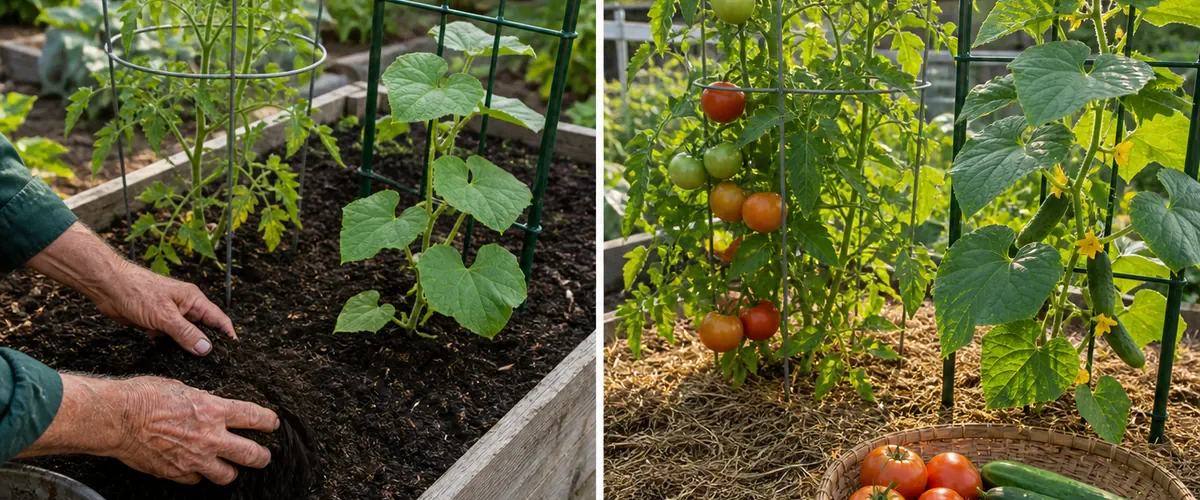
Follow the spacing on each variety’s label. Crowded leaves stay damp and hide pests. Cucumber vines can climb a strong trellis, keeping fruit straighter and easier to find. Install it before vines spread.
Stake or cage tomatoes at planting so later work does not damage roots. Indeterminate tomatoes need tall support; compact determinate types need less. Tie stems loosely with soft material and check the ties as growth thickens.
Water deeply at soil level
Push a finger below the mulch or use a small trowel to check moisture. Water when the root zone begins to dry rather than sprinkling on a fixed daily schedule. Apply water slowly at soil level until it reaches several inches deep.
Morning watering lets splashed leaves dry. Repeated shallow sips create surface roots and fast stress. Sudden swings from dry to soaked can contribute to cracked tomatoes and misshapen cucumbers.
Add two to three inches of clean organic mulch after the soil warms. Keep it away from stems to reduce rot and nesting places.
Feed according to growth stage
A strong transplant needs time to root before heavy feeding. Once flowers and fruit develop, follow a product labeled for fruiting vegetables. Do not pour concentrated homemade liquid around dry roots.
Pale leaves can come from wet roots, cold, disease, or nutrient shortage. Check the whole plant before adding fertilizer. More food cannot cure a vine with damaged roots.
Help flowers become fruit
Tomato flowers usually pollinate with vibration from wind and bees. In a protected space, tapping the support gently can move pollen. Cucumbers often produce separate male and female flowers; early male flowers may appear and drop before female flowers begin.
Grow flowers nearby and avoid spraying open blooms. If cucumbers form tiny fruit that yellow and fall, poor pollination may be involved. Hand pollination with a small brush can help when pollinators are scarce.
Inspect twice a week
Turn over leaves and look along stems. Aphids, whiteflies, mites, hornworms, beetles, and disease spots are easier to manage early. Remove a small pest by hand or with water where suitable, and use only treatments labeled for the exact crop and problem.
Do not work among wet plants, because hands and tools can move disease. Sanitize pruners between suspicious plants and remove badly diseased material according to local guidance.
Harvest to keep the plants working
Pick cucumbers while they are firm and at the size expected for the variety. Overmature yellow fruit signals the vine to slow. Cut rather than pulling and damaging the stem.
Harvest tomatoes at the color stage that suits weather and pests. Fruit showing its mature color can finish indoors if cracking, birds, or storms threaten it. Never eat fruit from a plant treated contrary to a product’s harvest interval.
Adjust the routine for containers
Use one large draining container for each tomato and a similarly generous home for compact cucumbers. Pots heat and dry faster than beds, so check them daily in hot weather without automatically watering. Support must be anchored so wind cannot topple the loaded plant. Container nutrients also wash out faster; follow a measured feeding schedule instead of adding handfuls whenever leaves look tired.
The habit that survives fifty seasons
The lasting trick is attention repeated before trouble becomes obvious. Prepare the soil, support early, water deeply, inspect leaves, and harvest on time.
One miracle scoop cannot replace those steps. A simple weekly routine can, however, keep tomatoes and cucumbers healthy enough to fill more baskets and make each season teach the next.