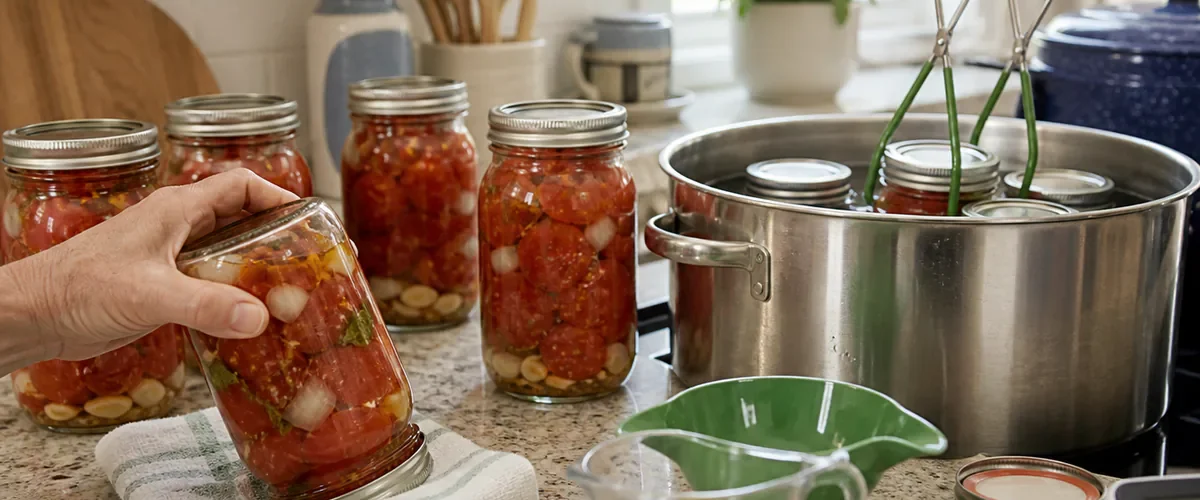
The jars clicked as they cooled, each lid pulling down into a neat seal. The tomatoes looked bright, the herbs floated beautifully, and the recipe promised a year or even two on the shelf. None of those signs proved the food was safe.
Tomatoes can sit near the acidity limit for boiling-water canning. Adding onions, garlic, peppers, oil, and fresh herbs changes the mixture. Safe shelf storage requires a current research-tested recipe, exact acidification, the correct jar size and headspace, and a complete heat process adjusted for altitude.
A Sealed Lid Is Not a Safety Test
A vacuum seal shows that the lid closed. It does not show that dangerous spores or toxins were controlled. Turning hot jars upside down and wrapping them in a blanket is not a substitute for processing in a boiling-water or pressure canner.
Botulism toxin cannot be seen, smelled, or tasted. Never sample a questionable jar to decide whether it is safe.
Use a Tested Recipe Without Creative Changes
Select a recipe from the USDA, the National Center for Home Food Preservation, or a current university extension source. Follow its tomato type, ingredient amounts, preparation, packing style, jar size, headspace, processing method, time, and altitude adjustment.
Do not add extra onions, garlic, peppers, fresh herbs, or oil unless the tested recipe includes those amounts. Low-acid ingredients can raise the pH, and thick mixtures heat differently.
Acidification Is Still Required
For tested directions for whole, crushed, or juiced tomatoes, the National Center specifies bottled lemon juice or citric acid in every jar. For a quart, the standard is two tablespoons bottled lemon juice or one-half teaspoon citric acid. For a pint, it is one tablespoon bottled lemon juice or one-quarter teaspoon citric acid.
Bottled juice is used because its acidity is standardized. Fresh lemon juice varies. Some tested tomato directions allow 5 percent vinegar at a larger amount, but it can change flavor. Use only the option named in the recipe.
Pressure Does Not Erase the Recipe Steps
When a tested tomato recipe offers both boiling-water and pressure-canning options, the acidification step still applies. The pressure option was designed as an equal process for the acidified product, not permission to remove the acid.
A pressure cooker is not automatically a pressure canner. Use the equipment required by the tested recipe and follow its venting, pressure, timing, cooling, and altitude instructions.
Prepare Jars and Lids the Current Way
Inspect canning jars for chips and cracks. Use the jar and lid system named in the guidance and prepare lids according to the manufacturer’s current directions. Keep rims clean, remove bubbles with a nonmetallic tool, and tighten bands fingertip-tight.
Process the filled jars for the full stated time. Start timing at the point required by the method. Do not shorten it because the contents entered the jar hot.
Cool, Test, Label, and Store
Let jars cool undisturbed for the stated period. Test seals as directed, remove bands if the guidance recommends it, wash residue from jars, and label the product and date.
Store sealed jars in a cool, dark, dry place. Quality is generally best within about one year, even when a tested product remains sealed longer. Refrigerate after opening.
Discard a Jar Without Tasting When You See Trouble
- The lid is bulging, loose, or leaking
- Liquid spurts or foams on opening
- The food has an unnatural odor or color
- There is rising gas, unusual cloudiness, or mold
- The recipe or processing history is unknown
Handle suspect low-acid food according to official disposal instructions. Keep it away from people and animals. Clean contaminated surfaces safely.
Use Freezing When You Want Recipe Freedom
If you want to improvise with oil, onions, garlic, and herbs, freeze a suitable cooked tomato mixture in freezer-safe containers instead of storing sealed jars at room temperature. Leave appropriate expansion space and label the date.
Check the Recipe Before the Harvest Arrives
Find a current tested recipe from the National Center for Home Food Preservation, USDA guidance, or a university extension program before buying ingredients. Confirm the jar size, tomato form, acid type, processing method, time, and altitude adjustment. Print or keep the complete directions where you can follow them without guessing.
Do not combine the acid amount from one recipe with the vegetables and processing time from another. Bottled lemon juice has standardized acidity; fresh lemons can vary. A pressure-canning option in a tested tomato recipe does not automatically remove its acidification step. Every part works as one tested system.
If a jar was made from an untested formula and stored at room temperature, do not taste it to decide whether it is safe. A pleasant smell and a firm seal cannot rule out dangerous toxin. Follow official disposal guidance for suspect home-canned food.
Those perfect-looking tomato jars carry an invisible risk when the recipe has not been tested. Use standardized acid, exact proportions, full processing, and altitude adjustment. The safe method may promise less than two years, but it protects the people invited to enjoy the harvest.