The orchid looked perfect at the store. Two weeks later, its flowers were falling and the leaves had lost their shine. That is when a bright yellow “rescue” tip often appears online: add lemon juice.
Lemon juice for orchids sounds sensible. Many orchids prefer slightly acidic conditions, and lemon is acidic. But there is a catch big enough to harm the plant. Fresh lemon juice is not fertilizer, its strength changes from fruit to fruit, and direct contact can burn tender roots or leaves.
The useful idea hidden inside this trick is pH. Once you understand that, you can help an orchid without turning its pot into a guessing game.
Why the Lemon Juice Trick Seems to Work
Plant roots absorb different nutrients more easily within certain pH ranges. Most common moth orchids grow well when their water and root area are mildly acidic, not strongly sour. Hard tap water can slowly push conditions higher and leave pale mineral crust on the pot.
A small amount of acid can lower water pH. That may be useful when tested water is too alkaline. Lemon juice can do this, but it is an uneven tool. One lemon may be much more acidic than another, so a recipe based only on spoonfuls cannot promise a safe final pH.
Lemon also contains sugars and organic material. Left in damp bark, these can support microbial growth. That is why lemon water should never be stored in the pot’s saucer or used as a regular tonic.
First Find the Real Reason Your Orchid Is Struggling
Falling flowers do not always mean the plant is dying. A bloom cycle naturally ends after several weeks or months. A sudden change in temperature, a cold draft, moving the plant, or fruit ripening nearby can also shorten the show.
Check the plant before reaching for any treatment:
- Roots: Healthy wet roots are usually firm and green. Dry roots may look silver. Brown, hollow, or mushy roots are damaged.
- Leaves: Firm medium-green leaves are a good sign. Very dark green may point to low light.
- Potting mix: Bark should stay open and airy. Fine, sour-smelling material holds too much water.
- Crown: Water trapped where the leaves meet can cause rot.
If roots are rotting, lemon will not revive them. Remove dead roots with clean scissors and repot the orchid in fresh bark. If the plant is healthy but will not rebloom, brighter indirect light is often more helpful than any homemade liquid.
The Safe Way to Think About Lemon Juice
Do not use a fixed recipe such as half a cup of lemon juice in a watering can. That can create a harsh solution. If you want to adjust alkaline water, measure the pH instead of trusting the spoon.
A careful test method
- Test your plain irrigation water with fresh pH strips or a calibrated meter.
- If the reading is already mildly acidic to neutral, skip the lemon.
- If it is clearly alkaline, add one or two drops of lemon juice to a gallon of water.
- Stir well, wait one minute, and test again.
- Continue one drop at a time only until the water is roughly pH 5.8 to 6.5.
- Use the water at once and let it drain completely through the pot.
Because meters and strips can be inaccurate, test them against a known solution and replace old supplies. A product made for adjusting plant water is more consistent than fruit juice and may be the better long-term choice.
Never Rub Straight Lemon on Orchid Leaves
Glossy-leaf videos make this look tempting. Straight lemon juice can irritate or mark leaf tissue, especially in bright light. It can also leave a sticky film that collects dust.
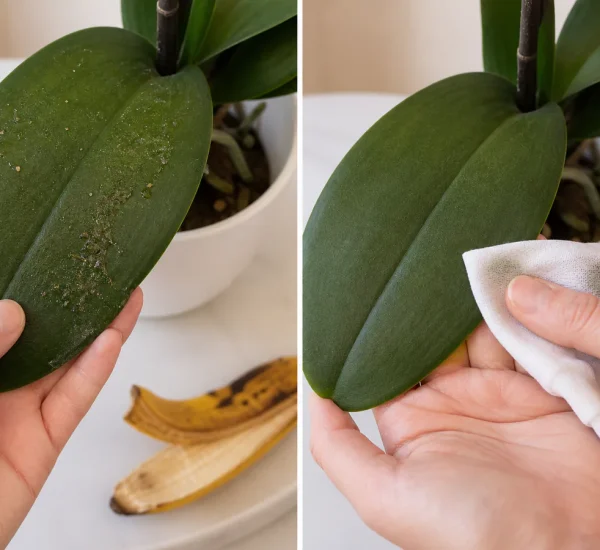
For clean leaves, use a soft cloth dampened with plain lukewarm water. Support each leaf with one hand and wipe gently with the other. Avoid commercial leaf-shine products, and keep water from pooling in the crown.
If lemon has already touched a leaf, rinse the area with plain water and move the plant away from direct sun while it dries.
What Actually Encourages New Blooms?
A healthy moth orchid usually needs patience more than a secret ingredient. Give it bright, indirect light near an east-facing window or behind a sheer curtain. Water when the bark is nearly dry, then drain it well. Feed active growth lightly with a balanced orchid fertilizer according to its label.
Many moth orchids begin a new spike after a small drop between daytime and nighttime temperature for a few weeks. Keep the change gentle and avoid cold drafts. The plant also needs time to store energy after its old flowers fade.
Look for a new spike between the leaves. It often has a mitten-shaped tip, while a new root has a smooth, rounded green end. Either one is good news.
Mistakes That Turn a Trick Into Trouble
- Adding lemon without testing: Acidity cannot be judged by taste or cloudiness.
- Soaking the pot: Orchid roots need air and should never sit in lemon water.
- Using lemon as fertilizer: It does not provide a complete nutrient balance.
- Treating every flower drop: Old blooms falling can be completely normal.
- Applying it to damaged roots: Acid can add stress to tissue that is already weak.
The Honest Result
The lemon juice orchid trick is not a bloom button. Its only reasonable use is as a carefully measured way to lower water pH when testing shows that adjustment is needed. For many homes, no lemon is needed at all.
Healthy roots, enough light, fresh bark, gentle feeding, and proper drainage do the real work. That answer may feel less magical, but it is far more likely to give you the surprise you wanted: a strong new flower spike rising from a plant you finally understand.