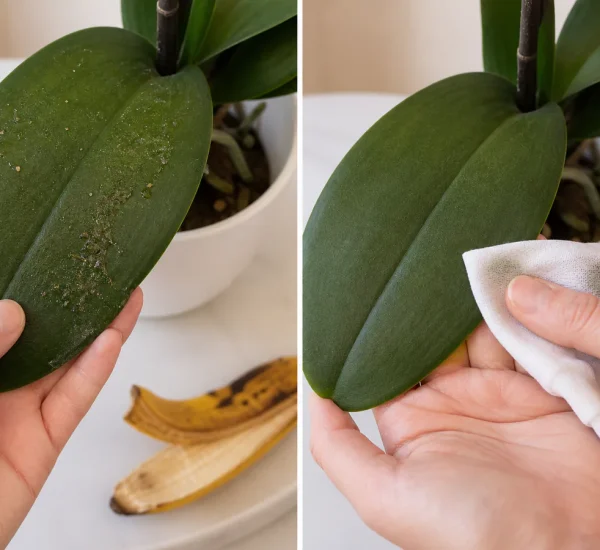
A firm green orchid leaf looks full of life. Place it in water, and it may stay green for weeks. That makes the popular idea of growing an orchid from one leaf feel almost certain to work.
Then nothing happens. No roots appear, the cut edge darkens, and the leaf slowly collapses. The problem is not your patience. In most common orchids, a detached leaf does not contain the growing tissue needed to build a new plant.
The missing piece is a viable growth point attached to stem tissue. Understanding that small detail can save months of waiting and protect a healthy orchid from an unnecessary cut.
Why an Orchid Leaf Usually Cannot Make a Plant
Many garden plants can form roots from an ordinary leaf or leaf cutting. Most Phalaenopsis orchids, the moth orchids sold in shops, do not reproduce that way. Their leaves grow from a short central stem, and new shoots come from specialized growing points.
A leaf blade alone may absorb water for a while, but it has no active node capable of producing a complete orchid. Rooting powder, charcoal, vitamins, or a long soak cannot create a missing growth point.
Some online methods quietly include a piece of stem with the leaf. That is no longer a simple leaf cutting. Removing stem tissue from a single-crown orchid can injure its only growing center and invite rot.
Look for a Keiki Instead
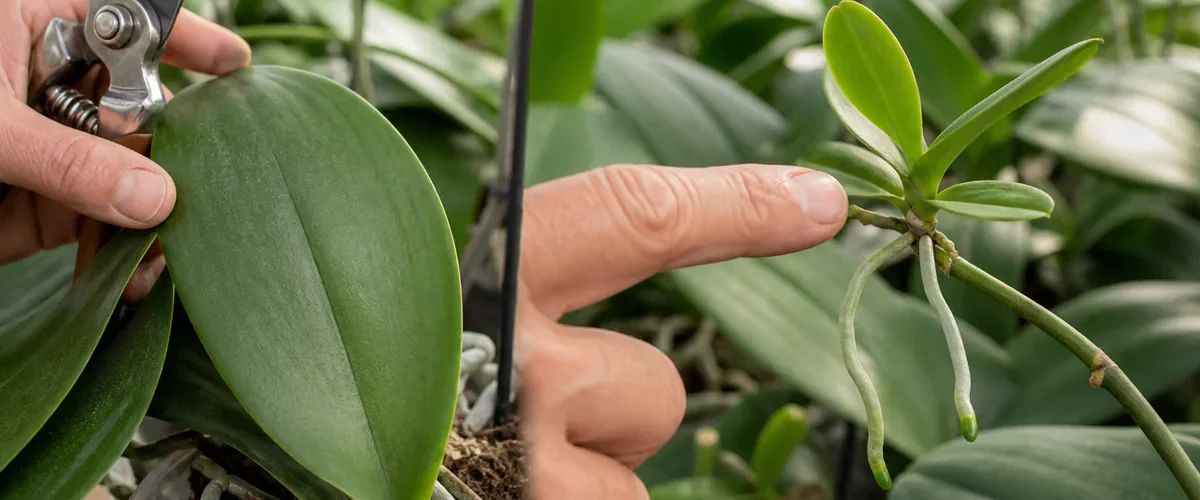
A keiki is a small plantlet that forms naturally on a flower spike or near the base of certain orchids. It already has leaves and a growth point, so it has a real path to becoming independent.
Wait until the keiki has several healthy roots that are roughly 2 to 3 inches long. Use a clean, sterilized blade to cut the spike on both sides of the plantlet. Pot it in a small container with airy orchid bark, keeping the crown above the mix.
Do not bury the leaves or pack the bark tightly. Give the young orchid bright indirect light, warmth, and gentle humidity while the roots settle in.
Use the Method That Fits the Orchid
Divide Sympodial Orchids
Cattleyas, Oncidiums, and many Dendrobiums grow along a rhizome and produce several canes or pseudobulbs. A mature crowded plant can often be divided during repotting.
Each division should keep several healthy growths and live roots. Tiny pieces have fewer stored resources and recover slowly. Cut only with sterile tools, and follow advice for the exact genus because different orchids respond differently.
Save Useful Backbulbs
An older leafless pseudobulb from a sympodial orchid may still contain dormant buds. If it is firm and disease-free, it can sometimes produce new growth in warm, humid conditions. This is a slow project, not a guaranteed shortcut.
A plain Phalaenopsis leaf is not a backbulb. Identifying the orchid before choosing a propagation method matters more than any homemade solution.
Keep Cuts Clean and Dry
Wash your hands and sterilize cutting tools before touching plant tissue. Use a new razor or disinfect pruners between plants. Never cut through mushy, spotted, or foul-smelling tissue and then use the same blade on a healthy orchid.
Let necessary cuts dry in moving air. Keep water out of the crown and leaf joints, where it can sit and encourage rot. Powdered products should not be packed into living roots, and household disinfectants should never be poured into the pot.
Be Careful With Hormone Pastes
Cytokinin paste is sometimes placed on a dormant flower-spike node to encourage a branch or keiki. Results vary, and a weak plant may spend energy it cannot spare. Too much can create distorted growth.
Use only a product intended for plants, follow its label, and apply it to one suitable node on a healthy orchid. Keep it away from skin, children, and pets. Do not spread it over leaves, roots, or damaged tissue.
Give the Parent Plant What It Needs
A healthy orchid is more likely to make natural new growth. Provide bright filtered light, a pot with drainage and airflow, and an orchid mix suited to the species. Water thoroughly, then let excess water escape.
Feed lightly with a complete orchid fertilizer during active growth. More fertilizer does not force propagation; it can burn roots and leave salts in the pot. Flush the mix with plain water at intervals and repot when bark breaks down.
The Leaf Test That Prevents a Costly Cut
Before removing anything, find the node, crown, rhizome, pseudobulb, or keiki that would supply a growth point. If you can see only a leaf blade and its base, leave it attached.
The surprising secret is not a magic rooting liquid. It is knowing which part can actually grow. Choose a real propagation structure, keep the parent healthy, and your next orchid has a far better chance of becoming more than a green leaf in a glass.